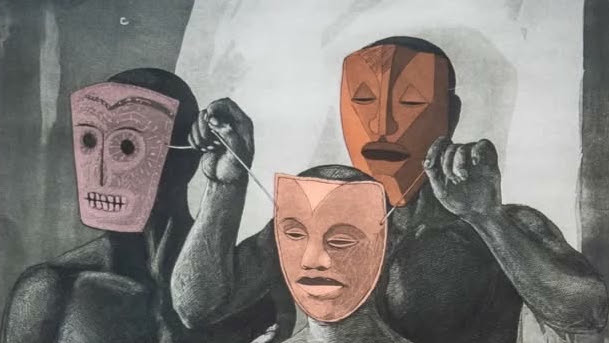
Photo of Unmasking, a painting by Anupam Sud.
No large-scale existing organization in the United States today claiming to fight for the liberation of women is free from the influence of the imperialist bourgeoisie, whose way of thinking dominates in society. Beginning in the 1960s there were many unsuccessful attempts to contest this influence in the women’s movement, attempts which began to decline in the 1980s and 90s.
The influence of the bourgeois “women’s movement” is declining with the worsening crisis of US imperialism. But the philosophical justification for imperialist intervention in the women’s movement that underpins the many women’s organizations that rely on state funding has been developing steadily in the philosophy and women’s studies departments of capitalist universities since the 1970s. Many prominent contributors to this philosophy are unable to avoid the truth of Marxism and so lay a claim to it, but in reality they oppose Marxism by attacking or undermining Marxist philosophy in an attempt to categorize it as “just another system.” Decades without a correct proletarian opposition have allowed this way of thinking to leave its mark on every part of the women’s movement today.
Generations of activists and revolutionaries in the United States, from the “New Left” and the “New Communist Movement” to today, have been unable to oppose the ideological influence of imperialism on the women’s movement and creatively apply Marxism to the women’s question. This led them 1) to allow male chauvinism and the abuse and rape of women to persist in their ranks, or to fail to fight them; 2) to abandon the struggle of LGBT people and even attack them on phony ideological grounds, especially at a time when US imperialism has targeted these groups even more violently; and 3) to bring us no closer to a correct understanding of the tasks of the women’s movement today.
This theoretical underdevelopment has lead to a profound confusion and eclecticism within the women’s movement. Comrades grasp each and every way trying to grab hold of a theorist or concept they think will help them makes sense of the women’s question in a revolutionary way. Oftentimes this has meant either a complete dogmatic insistence on only using a handful of revolutionary texts to understand the women’s question in modern times, or a completely eclectic approach wherein every writer and thinker, usually from academia, is imported into supposedly “revolutionary theory.” This theoretical anarchy is something that should be fought against, and in the final analysis it is a product of our own lack of good theoretical production as revolutionary women, and on the part of the revolutionary movement as a whole. This dangerous mix of dogmatism and theoretical anarchy then in turn often results in a kind of ideological-political centrism: taking positions while at the same time undermining them.
How do we avoid this eclecticism and centrism? To answer this, we should review those fundamentals of a good theoretical line in the women’s movement as laid down and developed by our predecessors in the struggle. First, we must recall that only a dialectical materialist approach will produce a correct line. Dialectical materialism takes material reality as a process or product of development, on which is constantly being made and remade under new conditions. Humanity and society are a product of development, not handed down by God. We can see this in the text Marxism, Mariátegui, and the Women’s Movement:1
Marxism, the ideology of the working class, conceives the human being as a set of social relations that change as a function of the social process. Thus, Marxism is absolutely opposed to the thesis of “human nature” as an eternal, immutable reality outside the frame of social conditions; this thesis belongs to idealism and reaction. The Marxist position also implies the overcoming of mechanical materialism (of the old materialists, before Marx and Engels) who were incapable of understanding the historical social character of the human being as a transformer of reality, so irrationally it had to rely on metaphysical or spiritual conditions, such as the case of Feuerbach.
Just as Marxism considers the human being as a concrete reality historically generated by society, it does not accept either the thesis of “feminine nature,” which is but a complement of the so-called “human nature” and therefore a reiteration that woman has an eternal and unchanging nature; aggravated, as we saw, because what idealism and reaction understand by “feminine nature” is a “deficient and inferior nature” compared to man.
For Marxism, women, as much as men, are but a set of social relations, historically adapted and changing as a function of the changes of society in its development process. Woman then is a social product, and her transformation demands the transformation of society.
When Marxism focuses on the woman question, therefore, it does so from a materialist and dialectical viewpoint, from a scientific conception which indeed allows a complete understanding. In the study, research and understanding of women and their condition, Marxism treats the woman question with respect to property, family and State, since throughout history the condition and historical place of women is intimately linked to those three factors.
Material social relations do not come from nowhere, but are the result of continuous development. Before the evolution of primate into human, the social aspect of the contradiction between biological and social was secondary. However, with the evolution of humanity through labor came the growth and qualitative leap towards “eusociality.” Humans are social in a way like no other animal as a result of our species’ need for social labor to produce the necessities of life. An ant colony may have complex social relations, but their social position in society is biologically determined and cannot be readily changed through social practice alone. Humans can change our social role through social practice.
It is for this reason that we must reject the vulgar metaphysical/mechanical materialism promoted by the bourgeoisie, which attempts to hide this history, instead ascribing particular social relations to “human nature,” “Black inferiority,” “women’s inferiority,” etc. Returning specifically to the question of women, the authors of Marxism, Mariátegui, and the Women’s Movement state that:2
the condition of women is sustained in property relations, in the form of ownership exercised over the means of production and in the productive relations arising from them. This thesis of Marxism is extremely important because it establishes that the oppression attached to the female condition has as its roots the formation, appearance and development of the right to ownership over the means of production, and therefore that its emancipation is linked to the destruction of said right. It is indispensable, in order to have a Marxist understanding of the woman question, to start from this great thesis, and more than ever today when supposed revolutionaries and even self-proclaimed Marxists pretend to have feminine oppression arising not from the formation and appearance of private property but from the simple division of labor as a function of sex which had attributed less important chores to women than those of men, reducing her to the sphere of the home. This proposal, despite all the propaganda and efforts to present it as revolutionary, is but the substitution for the Marxist position on the emancipation of women, with bourgeois proposals which in essence are but variations of the supposed immutable “feminine nature.”
The social inferiority of women is not an inherent one, but a product of a particular history. It is the result of the origin of the family and the maintenance of private property, and originated around the same time as the first class system (i.e., slavery) did. Yet the assumption that the social realities of men and women are simply the result of biological differences is incredibly common, and it crops up in many forms which must be done away with. For example, obviously those “revolutionaries” who claim that women are oppressed because of our sex are counter-revolutionary, for if our oppression is inherent how can we overcome it?
We can also see this erroneous trend in those who try and isolate the biological and social, pushing the line that biology is an unchanging substrate that exists in isolation from society. While obviously biology predates our society and history, our eusociality means that it is social relationships which determine and society which develops sex and sexuality.
This is why LGBT people have an objective existence, rather than being simply “ideological phenomena” of the modern day. There is a history of such phenomena in some form or another dating back through the primitive commune, slave society, feudal society, and capitalism today.3,4,5 LGBT people have always objectively existed in one form or another throughout history, even if they were denied liberation or proper self-understanding.
To digress, we can understand how each person can change their sex only within a species such as ours. Men and women as social beings as well as the basic facts of male and female biology form a contradiction, whereby the social aspect is determinate in the final instance. This is why, for example, intersex people can simply be men or women in society despite having biology which is often neither clearly male or female. In the case of transition, it is the result of any person growing and developing the social positioning and biological characteristics of the sex opposite to that which they were assigned at birth, while negating their original social positioning and biological characteristics. As a result, quantitative changes lead to eventual qualitative leaps to join the opposite sex.
In sum, our collective understanding of sex and sexuality has itself developed over the course of history, to the point that we can now understand these things as material and natural phenomenons. Harnessing these understandings is tied as well to our development of production, with new scientific developments relating to biology and reproduction in the modern era. Our new understanding allows us to see that our oppression is not inherent, but something we can change, remolding society and ourselves towards socialism and eventually communism.
With a better understanding of the Marxist line on women’s liberation, we can now turn our attention to an example of what a centrist or eclectic position might look like. We can take as a notable example that of the Red Star Communist Organization (RSCO) in their document “Half the Sky.” This article has been widely circulated among revolutionary women’s circles in the United States, and because of the lack of good theoretical production in our movement, it has played an influential role among some comrades almost by default. This article claims to take the left line in the Women’s Movement, and in many ways it does. But the RSCO also smuggles in several concessions to the right and ultimately their article holds a centrist position. Holding a centrist line is unacceptable because it paves the way for the imposition of right onto left.
First, we can see that RSCO has taken many solidly left positions. For example, they claim that the fundamental contradiction in the Women’s Movement is between the proletariat and the bourgeoisie, and that women’s liberation can only come from proletarian revolution.6 They claim that the liberation of LGBT people is inherently linked to women’s liberation, and that the struggle against patriarchy includes LGBT people as well.
We can identify the RSCO’s first mistake when they outline their position on the political economy of women’s oppression. They quote quite extensively from Friedrich Engels, for example his delineation of patriarchy and women’s status in society as being the result of a concrete historical development and transformation of social relations to create what we know as the monogamous family, and his discussion of the emergence of the bourgeois family and love marriage (as opposed to arranged marriage), which is a continuation of this understanding of the development of the family and family relations in class society by Engels.
All of this is correct, but unfortunately RSCO hides their own analysis in their “summing up” of Engels’ words. They claim that Engels describes the family as “an apparatus,” an echo of the anti-Marxist Michel Foucault and pseudo-Marxist Louis Althusser rather than Engels.7 And this apparatus is one they claim is “deployed” through “ideological reproduction.” In much the same way that Althusser’s “Ideological State Apparatuses” are used to smuggle in postmodernist lines, RSCO transforms the family from a real social relation that people enter into spontaneously under the material demands of class society and a material part of the superstructure of society, to a mere ideological apparatus that can be deployed by thought alone. Indeed, RSCO actually finds that work of Althusser’s compelling.8
This is clearly wrong. The family exists materially. When we as women are abused, attacked, beaten, and killed by men in our families, this is a material reality and not an ideological one. It reproduces itself not by ideology but by material political economic relations. The bourgeois man who does this is clearly doing it because it favors his material class interests. The family is what helps him maintain his power and wealth in a private domain, and to accumulate it and pass it down to his heirs. There is a clear financial incentive for a bourgeois man to participate in the worst patriarchal abuses to ensure his wealth is stable.
For working-class men there is a similar but slightly different reality. On the one hand, bourgeois outlooks including patriarchy are promoted through schools, media, and ruling class propaganda. On the other hand, working-class men have a minor financial incentive to uphold patriarchy and the family as it still provides them individual benefits. However, it must be noted that this is generally more common among the upper strata of the working class, such as the labor aristocracy, rather than among the poorest and deepest sections of the masses where it is an absolute necessity for both men and women in the family to work for income. In any case, we must affirm that principally the interests of working-class men and women are as a class first.
It is perhaps a little disappointing that our friends took such a centrist position on this important question. Attacks on women are only increasing every year in our own country and around the world. In some countries, the term femicide is used to describe the extent of the brutality perpetrated on women. Not an inch can be given in concession to the absolutely backwards idea that women’s oppression, the family, and patriarchy, are simply or mainly ideological.
Indeed, upholding this line actually has several alarming implications. For example, they claim that “gender ‘exists’ insofar as it serves to organize certain ideological constructions.”9 Despite their claim to reject bioessentialism, this is essentially a way of sneaking it back in. By taking “gender” to mean all social aspects and “sex” to mean biological sex, and then claiming that “gender” is simply ideological.
This is perhaps the actual broader problem with the so-called “sex-gender distinction,” which first emerged fully in the USA during the 1970s and 80s and served to push for a broad and accepting understanding of transgender people in order to eschew decades upon decades of strict medical industry restrictions on the ability of such people to access their healthcare. We can see today how it has turned on its head, and in some countries there exist “anti-gender” movements which use this particular understanding for anti-feminist and anti-LGBT purposes, claiming to just be “against gender, but in favor of recognizing biological reality.” Indeed, this framing itself did not come from working-class LGBT people themselves, but rather from postmodernist academics and petty-bourgeois LGBT activists. For example, Gayle Rubin in her 1984 essay Thinking Sex stated:10
Catherine MacKinnon has made the most explicit theoretical attempt to subsume sexuality under feminist thought. According to MacKinnon, “Sexuality is to feminism what work is to marxism . . . the molding, direction, and expression of sexuality organizes society into two sexes, women and men.” This analytic strategy in turn rests on a decision to “use sex and gender relatively interchangeably.” It is this definitional fusion that I want to challenge.
There is an instructive analogy in the history of the differentiation of contemporary feminist thought from Marxism. Marxism is probably the most supple and powerful conceptual system extant for analyzing social inequality. But attempts to make Marxism the sole explanatory system for all social inequalities have been dismal exercises. Marxism is most successful in the areas of social life for which it was originally developed — class relations under capitalism. In the early days of the contemporary women’s movement, a theoretical conflict took place over the applicability of Marxism to gender stratification. Since Marxist theory is relatively powerful, it does in fact detect important and interesting aspects of gender oppression. It works best for those issues of gender most closely related to issues of class and the organization of labor. The issues more specific to the social structure of gender were not amenable to Marxist analysis.
[Emphasis ours –Ed.]
This is an explicit rejection of Marxism as the ideology of the proletariat, all-powerful because it is true. Indeed Rubin actually goes on to promote “theoretical and sexual pluralism,” which poses sexual analysis as equivalent to Marxism.11 She proscribes analysis of the political questions of women and LGBT people as beyond the bounds of Marxist analysis. This is one of many examples of postmodern academics promoting alternative understandings which reject dialectical materialism, and imposing them onto working-class people from the towers of academia.
RSCO seems to claim that gender was created by the origin of the private family and class society. The implication that men and women did not materially exist before class society is frankly absurd. While clearly the social relations and ideologies present in society changed through each stage of the development of history, this does not mean that the development of our own understanding of ourselves as men and women (situated in a particular social context in a particular point in time) and our own understanding of the relations between ourselves are themselves synonymous with the very material existence of men and women as a whole.
While RSCO alludes to the New Communist Movement’s notable homophobia and anti-gay practices, it is notable that the NCM justified their practices on the same theoretical grounds that RSCO uses to describe any non-biological aspect of gender. Under their theory, gender transition is simply ideological rather than a material reality which predates class society and which has developed in practice over millennia as society itself has grown and developed. Under their theory, when the “ideological basis” for “gender” is done away with, the question remains what happens to all of us: men, women, gay, trans, and others?
What we can see from looking at our RSCO friends is exactly how not to uphold women’s liberation. When it comes to the details, they reject the Marxist position or at minimum make major concessions to reaction. This cannot be allowed, as this will inevitably lead to liquidation of revolutionary practice in the women’s movement.
Women’s oppression, and the particular oppression of working women, is a material, not ideological, fact. It results from a concrete historical development (emergence of the family and class society) rather than being inherent in some metaphysical way. While the origins of male and female are from the realm of biology, humanity’s principally social character means that our social reality is defined around social relations rather than biological aspects. While modern medicines can and will continue to change biology and reproduction, this is itself actually quite secondary to the social problem of women’s oppression. We can change our social status/role through social practice, revolution being the pinnacle of practice. It is through revolution, not “accepting biological reality” or postmodernist “oppression is due to ideology,” that we will be free.
1Pages 18–19, Marxism, Mariátegui, and the Women’s Movement. https://www.bannedthought.net/Peru/Mariategui/AboutMariategui/ElMarxismo-Mariategui-y-el-Movimiento-Femenino-MFP-1975-OCR-sm.pdf
2Page 21, Marxism, Mariátegui, and the Women’s Movement.
3Feinberg, L. (1996). Transgender Warriors.
4Sigal, P. (2017). Queer Náhuatl: Sahagún’s Faggots and Sodomites, Lesbians and Hermaphrodites. In Indigenous Religions (pp. 321–346).
5Lang, S. (1998). Men as Women, Women as Men: Changing Gender in Native American Cultures.
6Page 11, Red Star Communist Organization. (2024). Half the Sky: Preliminary Materials for a Proletarian Feminist Politics.
7Ibid, page 5.
8Ibid, page 13.
9Ibid, page 14.
10Page 33–34, Gayle Rubin. (1984). Thinking Sex: Notes for a Radical Theory of the Politics of Sexuality. https://www.ipce.info/library_3/pdf/rubin_thinking_sex.pdf.
11Ibid, page 34.
 La Obrera