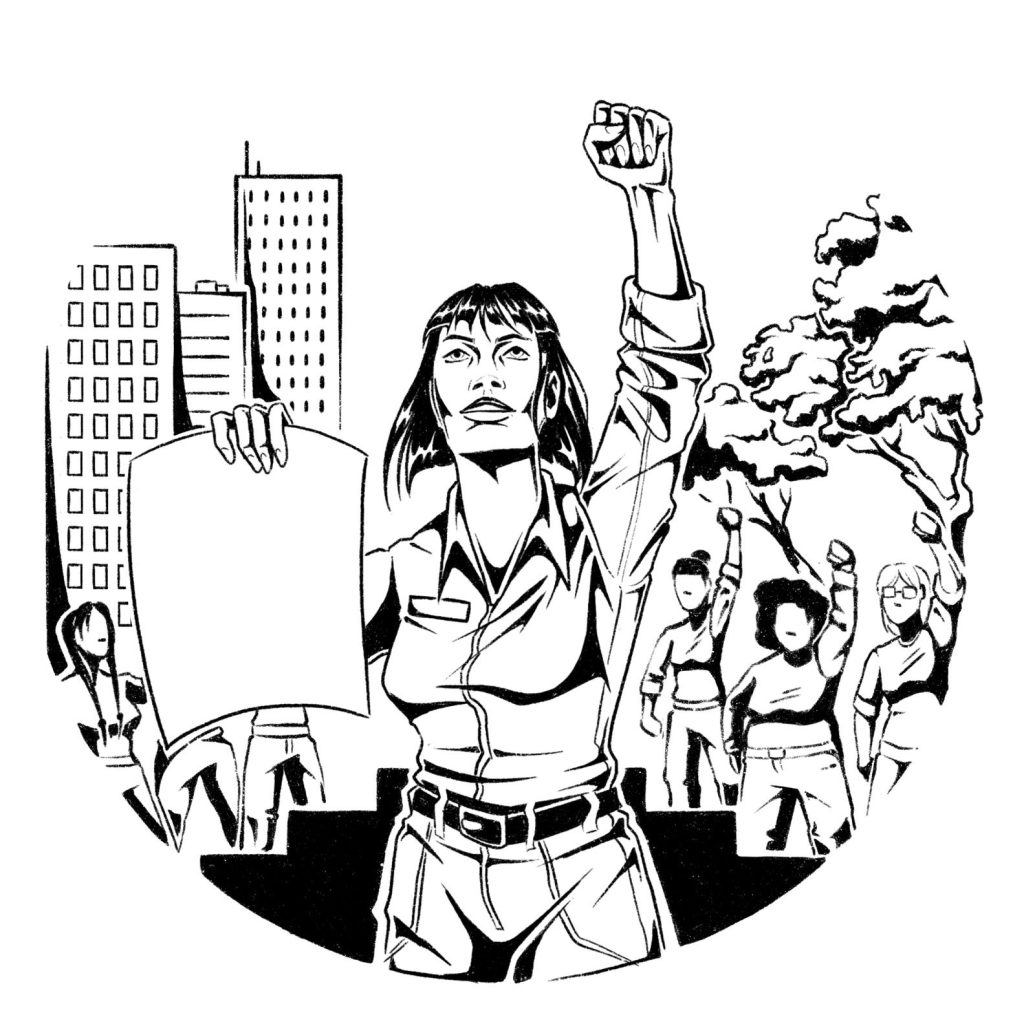
February marks one month before International Working Women’s Day (IWWD), a working-class holiday that belongs to the woman worker, and all women and people who desire women’s liberation and socialist revolution. Originally titled “Woman’s Day” when it was first held in New York City in 1909, it was popularized with the current name by Clara Zetkin in 1910 as part of that year’s International Socialist Women’s Conference. It was Vladimir Lenin who in 1922 gave the date as March 8th, and it is this date which working women around the world have commemorated ever since.
In the present day, the struggle of working women remains acute. For as long as there has been social stratification into classes, women have been oppressed under the justification that we are naturally inferior. This is still the case to an extreme degree in countries oppressed by imperialism, where backwards semi-feudal practices are still in use, and women’s lives are more or less as property to men. Even in the U.S., the ruling class still pushes women to prioritize having children, reproducing the family, and to serve men. As imperialism increasingly comes into crisis, the various rights and freedoms won through the historical mass movements for democratic rights, like the suffrage movement and civil rights movement, are being threatened.
The oppression of women is inseparable from the development of class society. Women’s subordination did not arise from biology or nature, but from definite historical and material conditions. With the emergence of private property and the division of society into classes, the monogamous family developed. In the words of Engels, “woman saw herself degraded, turned into a servant, into the slave of man’s lasciviousness, in a mere instrument of reproduction.”
The Popular Women’s Movement of Peru highlighted Engels main contributions, writing: “Investigating capitalist society and societies in general where exploitation and oppression prevail, Engels verified that misery, inequality and submission exist among men, and emphasizing the woman question he pointed out, ‘The state of affairs with respect to the equality of men and women is no better than their legal inequality, which we have inherited from prior social conditions, is not the cause but the effect of the economic oppression of women.’ And he continued ‘Women cannot be emancipated unless they assume a large socially measurable role in production and are only tied insignificantly by domestic work. And this has only been possible with modern industry, which not only admits feminine labor in a large scale but fatally demands it.’”
Under capitalism, this oppression takes on a specific form. Women are integrated into social production as wage laborers, yet they remain disproportionately burdened with domestic labor in the home.
In countries subjected to imperialist domination, semi-feudal social relations are often preserved or reshaped to serve global capital. In such conditions, women may face intensified forms of exploitation and patriarchal control, reflecting the uneven development characteristic of the imperialist system. However, these forms are not separate from capitalism but are articulated with it.
Within advanced capitalist countries, formal legal equality has been achieved in many spheres through mass democratic struggles. However, such gains remain limited within bourgeois society. As capitalism enters periods of crisis, the ruling class seeks to shift the burden of social reproduction onto working-class families, reinforcing reactionary ideologies about gender and the family in order to stabilize the system.
The full emancipation of women cannot be achieved within the framework of capitalism. Because women’s oppression is rooted in private property, class division, and the privatized family form, its abolition requires the abolition of capitalist relations of production. The liberation of women is therefore inseparable from the revolutionary struggle of the working class to overthrow capitalism and establish socialism, wherein socialized production and collective responsibility for social reproduction create the material basis for genuine equality.
This process of rising fascism, or fascistization, will increasingly attack working and oppressed people, especially women, in order to try and stave off economic crisis. For example, with the Dobbs v. Jackson Supreme Court ruling in 2022, the right to abortion in the U.S. has been increasingly restricted and attacked, now being illegal in 13 states and functionally illegal in many more through only allowing abortions in a very short timeframe since last period. Fundamentally, this is done to control working women. If we are forced to carry unwanted or unplanned children, we will take a high financial cost and raise a future worker—at virtually no cost to the ruling class. If we are banned from accessing abortion, we will be much more willing to take whatever jobs we can get, just to survive. Our willingness to accept exploitation will be higher. Abortion must be retaken as a fundamental right, by any means necessary.
As part of this renewed offensive of patriarchal policy, attacks on LGBT rights have continued to increase in the U.S. LGBT people, particularly transgender people, are similarly attacked by the ruling class because their rejection of the system of the traditional patriarchal family reduces the rate at which women can be pushed to reproduce the family and assent to further exploitation. In contrast to this, we hold that LGBT people’s rights, especially in the domain of healthcare, must be defended. We have seen in the past how attacks on LGBT healthcare, such as the State’s attack during the HIV epidemic in the 1970s–1990s lead to mass deaths.
The sexual exploitation of women remains a major global and domestic problem. Both within and without the traditional family structure, women are forced into a variety of forms of sexual exploitation. The sex industry has many domains, some of which are hard to track economically. Nonetheless, some estimates state that pornography is a $97 billion global market, while stripping and clubs are a $75 billion global market.1 So many demographics of women are targeted for the industry. Girls, and children generally, are targeted by the industry to serve the patriarchal and pedophilic preference for virginity. Sex trafficking of minors is incredibly common, with notable high-profile cases in the U.S. including that of Jeffery Epstein and Ghislaine Maxwell. Less high-profile and more common cases of child sex trafficking or child sexual exploitation come principally from children in or previously in the foster care system.2
For adult women as well, there is no doubt that sexual exploitation is a major issue. The overwhelming majority of women engaging in prostitution do so out of poverty. With limited avenues to financially support themselves or escape poverty, they turn to the only option left. This is fundamentally a social coercion which preys on vulnerable women to entrap them in sexual exploitation and systemic rape. There is a direct correlation between higher unemployment rate and higher prostitution rate.3 Fundamentally, prostitution, the sex industry, and sexual exploitation generally are problems specific to the working class. We can see how for the ruling class, the “counterpart” to the bourgeois family is infidelity and affairs, as well as engagement with the petty-bourgeois side of the sex industry; on the other hand, the working class’ “counterpart” to the bourgeois family resembles less the intrigue of an affair and more the systematic abuse, rape, and exploitation of women.
Nationally oppressed and immigrant women suffer particularly at the hands of the imperialist system. Native, Black and immigrant women suffer elevated rates of domestic violence, sexual violence, sex-trafficking, and so many other forms of patriarchal violence. For example, Black women are reported to be around 40% of trafficked women in the U.S., while only being around 13% of the population.4 Black women are also disproportionately affected by intimate partner violence.5 Trafficking and violence against Native women is also exceedingly high, with the term “Missing and Murdered Indigenous Women” used to refer to this violence. More than 80% of Native women have experienced some form of violence in their lifetimes, with half of this violence being sexual violence, both from sex traffickers and domestic partners alike.6 Intimate partner violence rates vary among immigrant groups, but rates have been estimated as high as 93% in some cases.7 Globally between 700,000 to 2 million people are trafficked internationally annually, over 80% of those people are women, and over 70% of those women are being specifically sex trafficked.8
While capitalism and imperialism remain the basis of the global economic system, it is fundamentally impossible to do away with all exploitation and oppression of women. Our oppression originated along with the formation of social classes and exploitation, and it will end along with it too. Unemployment and poverty are not exceptions to the capitalist economy but fundamentally part of it, and as a result the pressure to engage in prostitution and potentially get entrapped in inescapable debt under pimps will not simply go away through legal reforms. Fundamentally, as women our liberation will come from the struggles of working and oppressed people for a new society, free from imperialism and all exploitation. It is the duty of every working person, not just women but men as well, to uphold the necessity of women’s liberation.
We launch La Obrera with the hopes of establishing it as a tool for women’s liberation, national liberation, and socialist revolution, three goals which cannot and will never be separated for the women of our class. After years of patient work in our respective organizations and sectors, the contributors and editorial staff of our publication have created La Obrera so that we can begin to rectify the theoretical underdevelopment which plagues the women’s movement in the United States. We choose the name La Obrera, which means a woman worker or laborer in Spanish, in homage to the original CPUSA publication The Working Woman, and because of the inspiration we draw from the revolutionary women’s movement in Latin America and the lines which it has produced.
We aim for a revolutionary women’s publication that unabashedly takes the line of our class, the proletariat, the modern working class. We stand against the ideas and theories of the class enemy of the workers, the capitalist class, who through private property and patriarchal social systems keep women in general, and women workers in particular, oppressed and ultra-exploited. We stand for a clear eyed view of the women’s question, which so often becomes a second thought for many so-called “revolutionary” groups on the Left. We stand against the prevalence of reactionary misogynist leaders in many opportunist and revisionist organizations on the one hand, and the postmodern liquidationist practices of “call-out culture” on the other hand. Instead we stand for open struggle on women’s question and questions of misogyny on the Left, and stand for a revolutionary movement that takes women’s liberation as a central component part of its theory and practice which cannot be ignored nor removed. There are two lines within the women’s movement, a revolutionary line and a counter-revolutionary line. La Obrera is a fervent partisan of the former, of a revolutionary line which will carry all women and all workers and all humanity to liberation from oppression and exploitation.
In this first edition, we focus on establishing some of our basic positions, in relation to what revolutionary organizing in the women’s movement looks like, as well as in relation to contemporary positions on the women’s question in the revolutionary movement. Beyond our own practical experience struggling with these problems, we look to great women leaders of our class like Anuradha Ghandy, Clara Zetkin, and others, in addition to the ideology of our class, Marxism-Leninism-Maoism, for what a correct position in the women’s movement looks like. We march towards IWWD, and every day after it, as part of a new push for revolutionary women’s practice in our movement, and towards a rectification of failed and incorrect practices and theories which have held us back for decades.
International Working Women’s Day is not simply a day to celebrate the existence of women abstractly, but rather a day to celebrate the half of the international working class who faces the brunt of patriarchal oppression. International Working Women’s Day must be a day to push for a class-conscious women’s movement, one which strikes at imperialism and builds the ground for women’s liberation, every single year until we are free.
1Pages 66 & 86, Jeffreys, S. (2008). The Industrial Vagina: The Political Economy of the Global Sex Trade.
2Hannan, M., Martin, K., Caceres, K., Aledort, N. (2017). Children at Risk: Foster Care and Human Trafficking. In: Chisolm-Straker, M., Stoklosa, H. (eds) Human Trafficking Is a Public Health Issue. Springer, Cham.
3Cronley, C., Cimino, A. N., Hohn, K., Davis, J., & Madden, E. (2016). Entering Prostitution in Adolescence: History of Youth Homelessness Predicts Earlier Entry. Journal of Aggression, Maltreatment & Trauma, 25(9), 893–908.
4Meshelemiah, J. C. A., Thanises, A. C., & Yeboah, P. O. (2023). Sex Trafficked Women, Drug Dealers, and Men Who Buy Sex: A Look at “Race”. Violence Against Women, 31(2), 637-663.
5Waller, B. Y., Harris, J., & Quinn, C. R. (2021). Caught in the Crossroad: An Intersectional Examination of African American Women Intimate Partner Violence Survivors’ Help Seeking. Trauma, Violence, & Abuse, 23(4), 1235-1248.
6Page 2, Hill M, Anderson MB and King I (2022) Human trafficking as a racialized economy and the exploitation of indigenous socio-spatial (im)mobility in North America. Front. Sustain. Cities 4:884195.
7Morrison, A. M., Campbell, J. K., Sharpless, L., & Martin, S. L. (2023). Intimate Partner Violence and Immigration in the United States: A Systematic Review. Trauma, Violence, & Abuse, 25(1), 846-861.
8Green, S. T. (2008). Protection for victims of child sex trafficking in the United States: Forging the gap between US immigration laws and human trafficking laws. UC Davis J. Juv. L. & Pol’y, 12, 309.
 La Obrera