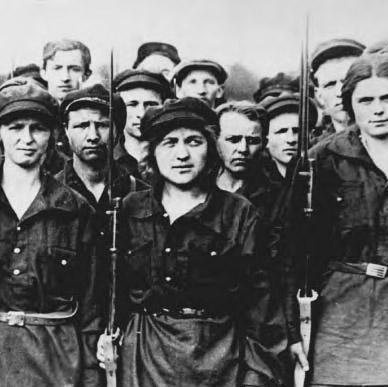
For the past decade, working-class women in the United States have experienced a furious assault at the hands of the ruling class. As the process of fascistization intensifies, hard won victories achieved in the class struggle such as the right to abortion are continuously overturned. Violence against women and prostitution/sexual exploitation remain incredibly common, and the gender pay gap has in fact widened for two consecutive years.1 The triply oppressed section of women who simultaneously experience class exploitation, gender oppression, and national oppression are increasingly subject to heinous acts of patriarchal violence, such as the forced sterilization and systematic sexual assault which have been reported from inside ICE detention facilities. In order to combat this renewed war upon women, it is necessary to construct a revolutionary, class conscious women’s movement along correct organizational lines, based on and lead by the women of our class and those who hold the stand of our class.
The contemporary women’s movement can be broadly broken down into three organizational trends: 1) the bourgeois women’s organizations, 2) the mutual aid/book club trend, and 3) the trend of crude separatism, that is, treating the work of women’s emancipation as organizationally independent from all other forms of work. While each of these trends has its own particular problems, they share the common thread of holding back the development of a revolutionary women’s movement based in the class line of the proletariat.
The bourgeois women’s organizations include those Democratic Party-formed or controlled organizations, the state union caucuses or departments and organizations within women-dominated trades, and the numerous “feminist” NGO’s who pay lip-service to the cause of women’s liberation while ideologically, politically, and financially backing the patriarchal, capitalist dictatorship which keeps us in bondage. These organizations’ practice is limited entirely to what the bourgeois state deems appropriate; they are arms of the same party that refused to codify Roe v. Wade into law for years; the same NGO’s who collaborate with imperialism; the same state unions, who lobby for decrepit, rapist imperialists in the Presidential elections. In the face of a declining liberal-democracy, an imperialist society in the process of fascistization, they seek not to develop a combative movement capable of establishing a new society free from all forms of exploitation, but merely to restore political power to the representatives of the traditional liberal-democratic order which has led us here in the first place. Revolutionary proletarian women have no choice but to view these organizations as part of that “enormous pile of garbage” which must be swept away in the course of building our own organizations.
Intimately connected to this first group of organizations are a slew of revisionist and class-collaborationist organizations masquerading as “revolutionaries” and “socialists” who conduct their work in the women’s movement either exclusively through, or in close collaboration with, these state-sanctioned organizations of our enemy. These organizations dress themselves in Marxist language, rhetorically acknowledging the principal contradiction of capitalist society as that between labor and capital, while simultaneously asserting that we must unite with these bourgeois women’s organizations to fight for the particular demands of women, such as access to abortion, an end to the gender pay gap, etc. They use this collaborationist logic to justify entryism into the bourgeois organizations, and to uncritically unite with the political actions of these organizations at every turn, thus betraying any semblance of independence for the working class and its women in political struggle.
Among those who generally consider themselves more “left” than the out and out bourgeois women’s organizations and the class collaborationists who engage in entryism within them, it is common to build structures dedicated to mutual aid and/or study around the women’s question. These forms of practice and organizational structure became “common sense” practice throughout the revolutionary movement in general from the late 2000’s–late 2010’s, and the women’s movement was no exception.
It is still common today to see women’s organizations whose pinnacle of practice deals mostly with handing out free food, groceries, and period packs in the name of “improving material conditions under capitalism,” and “survival pending revolution.” Oftentimes, there is a coinciding justification that the charity work these organizations engage in politicizes and educates the people being served by the programs either by demonstrating that the masses of oppressed and exploited women cannot rely on the imperialist state for the resources being provided, through the flyers or pamphlets being distributed alongside the materials, or a combination thereof. The intention for many organizations is that the women serviced through these distributions read the political pamphlets provided during the distribution, see the flyers for follow up events (usually study groups), and are then stirred to action. This line of logic has been followed innumerable times all across the revolutionary movement over the past two decades with basically the same results; the women’s movement is no exception here.
There is certainly a place for mutual aid work in the women’s movement, just as there is a place for study groups in the women’s movement, however these organizations cannot and should not be the main basis of activity for the revolutionary women’s movement. The real fruit of this style of work is often nothing more than a lesson. Countless dedicated, well-meaning activists have burned themselves out on years of fundraising, logistical coordinating, packing, and distribution with little tangible victories to show for it. Volumes of summations and self-criticisms have been produced as a result of this mutual aid/study group style of work which all distill the same basic lesson: class struggle is what mobilizes the masses and builds a movement, not charity and book clubs. The bulk of the activity of a revolutionary women’s movement must occur in the class struggle, whether that be in independent women’s organizations or as departmental work within already existing organizations of masses in the labor struggle, the neighborhood defense movement and among the youth.
The mutual aid/study group style of mass work necessarily seeks not to mobilize the masses against their political enemies for demands, politicize them through propaganda and summation, and then organize them for power, but instead to engage the broad masses only through providing them with an abstract intellectual understanding of their oppression and/or provide services which fill gaps which exist in bourgeois social programs; this is the practice of conducting mass work at the margin of class struggle rather than within it.
The tasks of the revolutionary women’s movement is more than developing a conceptual understanding of our exploitation, oppression, and the necessity of revolution, and it is certainly more substantial than doing the job of the bourgeoisie for them (i.e. making capitalism more comfortable)! We share the historic task with our entire class, irrespective of gender or nation, to defeat imperialism, and usher in an era free of class distinctions and exploitation! The limits of the mutual aid/study group organization are not conducive to this end; we must go beyond the confides of these structures, to the lowest and deepest sections of proletarian women, uncover their basic demands, and mobilize, politicize, and organize them along these lines towards political power.
Finally, outside of the NGO and mutual aid trend, there are those organizations which push for women to be organized, perhaps along revolutionary lines, but separately from all other sectors of struggle. The most classic example of these organizations were the “women’s collectives” that appeared throughout the country during the New Communist Movement. The origins, activity and structures of these groups vary, but their separatist format binds them.
These organizations might be created because of a so-called “radical feminist” political line, as a spontaneous separatist reaction to misogyny and other problems of chauvinism in a male-dominated political space/organization, or because of a misapplication of the correct desire for distinct organizations in the women’s sector. They are often more short-lived and spontaneous than the other two dominant types of women’s organizations, although that is not always the case. Some are struggle-oriented, although many are more eclectic or cultural and life-style focused.
Some of these organizations have the potential to be play a progressive or class-conscious role in certain situations, especially if they are struggle-focused, but ultimately in most cases these organizations play an almost entirely negative role in the revolutionary women’s movement. They promote the illusion that our liberation can be won without the participation of and leadership alongside men, that our struggle can be separated from working-class revolution. The institution of private property, the origin and main sustainer of patriarchy, cannot be defeated without socialist revolution and without the participation and leadership of all members of our class, united as one.
Really these organizations are quick politically incorrect shortcuts to the very complicated problem of developing women’s organizing as part of a larger cohesive revolutionary strategy, and organizing existing revolutionary organizations such that they deal with the problems of misogyny and abuse within their ranks in a correct and consistent way.
What then, does a revolutionary movement and organization of women look like in a US context? In Marxism, Mariátegui, and the Women’s Movement, the Popular Women’s Movement of Peru state that when conceiving of a “movement generated by the proletariat among the masses of women” we must consider two problems:
- “Ideological-political construction, which necessarily implies providing it with Principles and Program;
- Organizational construction, which we can serve by forming cores or groups of activists for carrying the Principles and Program to the masses of women—workers, peasants, professionals, university and secondary school students, etc.—They would work toward the politicization of women, mobilizing them through their struggles and organizing them to adhere to the political struggle, in harmony with the orientation and politics of the proletariat.”
Considering these two problems, we begin with the first: in a US context there is not yet a real and tested program any group can put forward on the woman question. There are, however, basic principles we can put forward. The provisional principles of class-conscious and revolutionary women’s organizing La Obrera upholds are:
- Anti-imperialism
- Anti-reformism and anti-electoralism
- Anti-chauvinism, in all forms
- We, the revolutionary women’s movement, must be based on a working-class perspective
- We must be based on the struggles and problems of the female masses
- We must construct our movement in support of and as a central part of the broader socialist revolution
On the basis of these political principles, we at La Obrerahave united on a provisional line of organizational construction in the revolutionary women’s movement.
- Revolutionary women’s organizing should not be a side thought or an entirely separate initiative, but an important component part of the broader plan and activity of revolutionaries in a given area or sector. Thus, the forms, the activity, the goals and organizations of such work should be determined on the basis of a revolutionary line, which we attempt to elaborate in this edition, in combination with an assessment of the particular conditions and array of forces of the site of struggle in question. Revolutionary organizations must place a particular emphasis on training up and developing women leaders and activists within all our organizations and our broader movement, as part of this work.
- We support a mix of organizationally distinct women’s sectoral organizations as well as formally organized women’s sectoral work within organizations conducting work in other basic sectors (e.g., labor, neighborhood, student and youth, national liberation). Departmental work, whether it be on the basis of the particular demands of women or the nationally oppressed or the LGBT masses, should be already organized and incorporated into the work of the existing mass organizations in a given area or sector. Whether or not organizationally distinct women’s organizations should be created in a given sector or area should be determined as part of the broader work of revolutionary planning and assessment.
- Regardless of its form, revolutionary women’s organizing should be based on the same basic set of class-conscious united front principles and program that other mass organizations are united upon. Within this common program of struggle basic points on women’s liberation must already be present, and on the basis of this common program additional demands and particular programmatic points made, by publications and organizations like La Obrera. All revolutionary women’s organizations should base themselves on the participation and leadership of working women, and should be partisans of our class.
- Above all else, revolutionary women’s organizing must take class struggle as its key link, as its central focus, and needs to be sharpened in the struggle against opportunism, revisionism, and reformism. There are many incorrect lines in the current women’s movement and many incorrect positions on the problem of opportunism on the women’s question. It is our difficult but necessary task to forge a revolutionary path within the swamp of capitalist and reformist feminism, to fight against the den of rapists and misogynists that characterizes the political organizations of the capitalists and false “revolutionaries” without falling into either anarchism or separatism.
1Institute for Women’s Policy Research. (2025). IWPR’s New National Annual Women’s Wage Gap Analysis Shows Second Consecutive Year of Decline. https://iwpr.org/iwprs-new-national-annual-womens-wage-gap-analysis-shows-second-consecutive-year-of-decline-2/.
 La Obrera