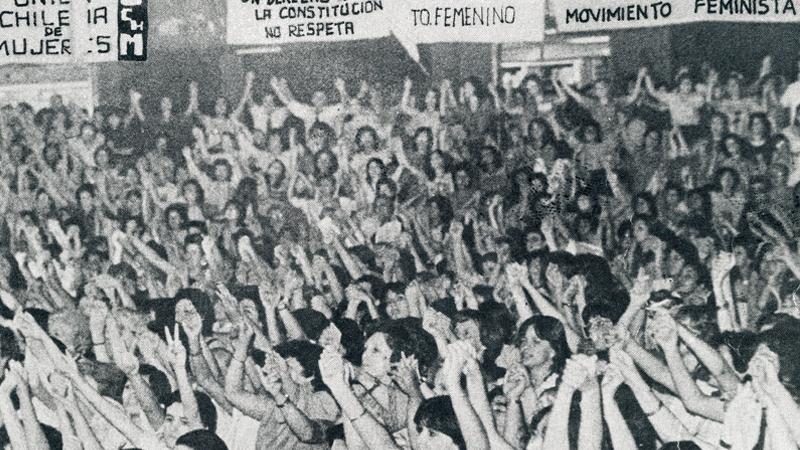
Photo of the Unión de Mujeres de Chile in 1976.
In the past several decades of the revolutionary movement, bad policy regarding male chauvinism and violence against women has resulted in the disintegration of countless organizations. Our organizations are fundamentally products of class society, and even revolutionary organizations are born marked by the same ills and problems that we have not yet overcome through revolution. As such, it should be no surprise then that just as women face violence and abuse in wider society, so too do we face violence and abuse within revolutionary organizations and activist spaces. The masses need class-conscious fighting organizations that enable them to win demands and conquer power, and not short-lived dysfunctional organizations that do little and end catastrophically after errors of male chauvinism and sexual violence come to light.
Thus, the pressing question is how to approach these issues from a proletarian perspective. Many organizations have no line on these issues or have a backwards, incorrect, and non-proletarian line. As Lenin sharply pointed out:
The workers were never separated by a Great Wall of China from the old society. And they have preserved a good deal of the traditional mentality of capitalist society. The workers are building a new society without themselves having become new people, or cleansed of the filth of the old world; they are still standing up to their knees in that filth. We can only dream of clearing the filth away. It would be utterly utopian to think this could be done all at once. It would be so utopian that in practice it would only postpone socialism to kingdom come. No, that is not the way we intend to build socialism. We are building while still standing on the soil of capitalist society, combating all those weaknesses and shortcomings which also affect the working people and which tend to drag the proletariat down.
Directly intervening into this topic, we will outline our basic principles of conduct and handling violence against women within revolutionary organizations based on the universal aspects of Marxism-Leninism-Maoism, particularized and creatively applied to the sector of women and the women’s struggle. To understand why this universal basis for our principles is important, we can take inspiration from the Communist Party of India (Marxist-Leninist) [People’s War] in their 2001 document Our Approach To The Women’s Question:
A good number of socialist feminists including bourgeois feminists constantly demand the women’s movement to preserve its “autonomy” and “independence” from the organisational influence of the communist party. Thereby it seeks to secure the influence of the bourgeoisie instead of that of the proletariat over the women’s movement.
We fight against the trend of bourgeois feminism by imposing the universal principles of the proletariat as a whole, principles that encompass and embody all aspects of the political and organizational life of an organization, from democratic centralism to the correct organization and handling of two-line struggles and contradictions among the masses, that all comrades must strive to uphold and practice from the start. If we promote the methods, stand, and line of our revolutionary women’s movement as an autonomous or otherwise separate force from the broader revolutionary movement, we would promote a revisionist position that serves the bourgeoisie and not the proletariat, especially working women.
Given that male chauvinism and violence against women are preexisting problems in society and in activist spaces, we must not simply wait for them to occur. It is an unfortunate reality that this is a question of when rather than if. These problems exist under capitalist society and won’t be truly resolved until the establishment of a Communist society, with the end of the system of private property that marked the subjugation of women, and thus they must be constantly combated until that society free from all forms of oppression exists. We must be proactive and not reactive, to catch problems as early as possible and have proper mechanisms for dealing with them. It is a form of liberalism to let these problems go uncombated, and instead we must teach and build up healthy and correct social relations among activists and masses alike.
Our goals when considering standards of conduct and discipline serve the ultimate aim of socialist revolution and women’s emancipation. We do this by organizing collective struggle against male chauvinist conduct within our ranks and raising up women in our organizations as revolutionary leaders. We work actively to raise the level of participation of women in our organizations and strengthen our work among the women masses and working women in particular.
When considering the question of discipline, as we have established, we should look to the universal lessons of our ideology for guidance. We use universal principles from our ideology to discipline ourselves. On a basic level, we rely on criticism/self-criticism, political education, rectification through class struggle, the minority submitting to the majority, lower bodies submitting to higher bodies, and assessing and making decision from an all-sided materialist standpoint. When practicing criticism and self criticism, we should apply the principle of “curing the disease to save the patient” while also taking the approach of protecting the masses and activists within our organizations from all forms of abuse and mistreatment at the hands of reactionaries and opportunists. It is crucial to identify who upholds correct principles on male chauvinism and violence, not only in words but in practice. We apply the mass line by identifying the advanced, those who uphold correct principles on male chauvinism and violence in practice, and mobilizing them to win over the intermediate who may have some backwards views or practices but are willing and able to change and correct themselves and their conduct. Only the most unrepentant chauvinists and abusers must be isolated and exposed before the masses.
What are some proactive practices revolutionary organizations can implement to combat male chauvinism within their ranks?
Organizations which uphold, organize, and correctly implement the revolutionary practices of criticism/self-criticism and two-line struggle will be much better inoculated to combat a whole array of internal errors, including male chauvinism. Consistent and regular practice of criticism/self-criticism by both leading activists and rank-and-file members every few months or every given period of work, before and after actions/events, etc., allow chauvinist tendencies to be identified and struggled against effectively and quickly. Such practice is also essential for these tendencies to be corrected and rectified in any meaningful way and serve as a first step before more severe disciplinary action such as suspension or expulsion are taken. Similarly the practice of organized and collective two-line struggle allows for male chauvinist positions and lines to be identified and eradicated, and for our proletarian feminist line to be strengthened, on an ideological-political level.
Democratic centralism and collective leadership are also important practices for organizations who hope to forge standards of conduct and disciplinary protocols which serve women’s emancipation. Democratic centralism can be summed up as the individual submitting to the collective, lower bodies submitting to higher bodies, the minority submitting to the majority, and freedom of discussion combined with unity of action. Democratic centralism and collective leadership are based on the idea of a division of labor and structure that is decided upon both democratically and centrally, in dialectical relationship with one another. This way democratic discussion can be translated into solid unity on policies and actions to concretely uphold a correct line on the Women’s Question. Such a strong foundation of principles allows us to combat the idea that many male chauvinist opportunists put forward that they are somehow entitled as individuals to leadership positions or membership, or that collective discipline can be avoided or escaped if they disagree with the judgment or decision. With democratic centralism and collective leadership, members and leaders alike must submit to the collective will of the working-class, must submit to the decisions we take in order to impose our proletarian line on the bourgeois line.
As an extension of these practices, revolutionary organizations with strong theory and practice on the women’s question almost always have good internal protocols and culture regarding the social and personal relationships among the membership of the organization. In general, dating between members or between members and mass contacts should be strongly discouraged, and in some cases forbidden. The reasons for such an orientation towards romantic relationships in political organizing are straightforward. Firstly, we should combat the practice of “macktivism,” i.e. those often petty-bourgeois men who enter political organizing in part in order to find a partner. Second, dating within the organization can open up a whole host of potential errors and issues associated with unprofessionalism, intimate partner violence, and unhealthy power dynamics. Thirdly, breaks-ups, divorces, arguments, etc., will inevitably happen in the course of many relationships, and these personal problems that can very easily introduce discord and problems into the political work. These issues, owing to the lack of a correct proletarian revolutionary attitude, have caused great harm to progressive organizations and ended up reflecting women’s oppression within organizing spaces.
It is also true that there are many historical examples of comrades whose romantic relationships were complimentary to their service on the front lines of revolutionary struggle. If members are in a romantic relationship, it must be emphasized that their relationship is inherently tied to and subjected to their political work. In revolutionary movements in the oppressed countries, it is often said in that “what is personal is political”: there are no “personal decisions” or “private life” separate from one’s existence in society. As revolutionaries aiming to change society for the better, it is imperative that they embody this in all aspects as a part of the revolutionary organization. There are procedures to conduct such a relationship within an organization. The organization must routinely check in with both partners to ensure their relationship is and remains healthy and functional, and keeps itself aware of any potential problems between them. The activists in a relationship must never place the individual interest of their partner above the interest of the revolutionary movement. There should be comrades who are assigned to keep this routine contact, and provide a safe person to which each partner can separately go to report problems and get support. Through this process, partners have safe avenues to help with their relationship problems, to proactively catch and prevent chauvinism, violence, and abuse, and to help them end the relationship if need be. It must be emphasized that their activity and membership within the organization is not subjected to their romantic relationship, and we must combat the tendency that is far too common of one or both people leaving an organization after a break-up because of unhealthy or dysfunctional lingering dynamics.
We must also combat gender separatism within our organizations, which often emerges spontaneously in the social sphere. If all the men and all the women in an organization are mainly interacting with the same gender during the course of its internal political and social life, that is simply unacceptable. This separation is a product of patriarchy and class society. Our aim, communist society, will be a society where men and women are total equals and participate in the collective life of society. On the one hand, this separation allows for the proliferation of patriarchal “boys’ locker room” culture, inculcated in men from childhood to treat women not simply as different but inferior. We must combat from the position of the proletariat, understanding that despite any differences we are all fundamentally equal members of the class, and any bourgeois ideology and practices among us must be purged as part of our emancipation. On the other hand, it also can lead to criticisms of male chauvinism within the organization becoming concentrated in private conversations among female comrades. This can then impede confronting and resolving the issues in question democratically and effectively, and instead fester into factionalism or liquidationism as the contradictions intensify.
What should the disciplinary process look like when allegations and cases of misogynist abuse, sexual violence, and male chauvinism do arise within our organizations?
There should first be an initial assessment based on the information made preliminarily available. If there is a risk of actual or probable danger to the person alleging the abuse/violence, the immediate step must be to secure the safety of the victim and all others who may be at possible risk of harm from the accused. Following this step, or if such risk is assessed as unlikely, a grievance committee should be convened to conduct the investigation and issue or not issue discipline according to the rules and bylaws of the organization in question.
Once this is in place, then all facts of the matter must be gathered, and responsible leadership must determine the validity and severity of the claims made. In many cases the evidence is clear-cut, while in others there may be confusion that must be cleared up. Given the tendency of chauvinists and abusers in obfuscating their errors and crimes, it is necessary to seek truth from facts and form an objective picture of the situation at hand. There may be further errors and abuses discovered during this stage of investigation. Once an objective picture is reached, then conclusive action must be taken. In cases of sexual assault or rape, the perpetrator must be expelled from the organization. Measures must be taken to ensure they cannot go on and repeat their crimes in other organizations. These measures include practices such as continued monitoring of their activities or sharing reports of their crimes to other revolutionary organizations in the area.
We are against the practice of public doxxing of legal names and identities. We are however for the practice of securely sharing necessary information regarding die-hard opportunists who have been expelled or isolated because of their crimes. This applies in general, not just in relation to the question of male chauvinism. For example, if somebody in your organization turned out to be an informant for the State, or was embezzling funds, both of which are crimes worth expulsion, and they ran off to escape discipline and continue political work in new organizations, you would be obliged to appropriately inform other activists and the masses generally of the history and actions of this die-hard opportunist. There is no reason to make an exception to this basic principle of discipline for questions regarding sexual violence and male chauvinism.
We have no obligation to protect those who commit crimes worth of expulsion, or who split, expel themselves, change their organizing names, etc., because they are unwilling to rectify and submit to revolutionary authority and discipline. The tool of exposure, especially exposure before the masses, is an important tool in the struggle against all types of opportunism and revisionism, and we should make no exception with regards to the Woman Question. We should delineate between leaders and masses, with leaders being held to the highest standards, and use severity as a metric for our response. Bad elements can and will try and continue perpetrating their crimes in other organizations, neighborhoods, and cities if they can. Thus the correct approach to isolation means working together with other revolutionary organizations as a united front against opportunism, to ensure that unrepentantly backwards elements are weeded out and truly isolated to prevent them from affecting the work of our movement.
Some revisionist organizations, such as the PSL, FRSO, and The Worker, fear the struggle against opportunism and conflate it with “police work” such as doxxing or snitching. They use the logic of corporations and capitalist politicians like Trump: deny, deflect, and lie in the hopes that they can escape the fury of the masses and the consequences of their crimes. To argue that the fighting and exposure of opportunism is “police work” goes against two hundred years of revolutionary history, theory and practice, and would doom our movement to be dominated by opportunism and revisionism until the end of time. Ultimately, the strategy of lies and obfuscation can only take our US opportunists so far, and as the powerful movement of revolutionaries and masses aimed at socialist revolution grows, these opportunists will either submit to rectification or be removed like so many before them.
Taking a proletarian line on the Women’s Question is not simply a matter of having the right ideas, but by making these ideas reality through social practice in struggle. In applying the principle of the two-line struggle, we apply our political line on the Women’s Question to our work in the class struggle and ensure adherence to these standards. We unite ourselves with the people by differentiating right from wrong and friends from enemies. The left line must must unite, differentiate, and lead. In this way, we impose the left line on the right before the right line becomes an organized force that can potentially overpower it. Two-line struggle on this and all other pressing questions of our movement is a duty of each and every child of the proletariat. It is a duty of revolutionaries regardless of gender, to impose the left line on the woman question, and all related political struggles, on the right.
The women’s movement is a part of the general revolutionary movement, and women’s emancipation will only occur through the general liberation of the working class achieved through first the establishment of Socialism and eventually Communism. Struggle is the key factor, whether it be in local and immediate two-line struggles, in the Socialist Revolution, or in subsequent Cultural Revolutions towards Communism. It is for this reason that a correct or incorrect line on the woman question can be used as a litmus test in determining who is and who is not a revolutionary. While it is not the sole determining factor in this determination, an incorrect line on the woman question and incorrect practices in this field cannot simply be brushed aside.
Correct standards of conduct and practice are born out of years of struggle and experience, learning right from wrong, correct from incorrect by doing, by daring to struggle and daring to win. As our movement develops grows to the tens of thousands, and later millions, the policies, protocols and principles in this article will be sharpened, adjusted and improved in the fire of class struggle. Let us make our revolutionary line a material force through actions and deeds! Socialist revolution, the overthrow of US imperialism, and women’s emancipation are on the horizon; let us sharpen and strengthen our organizations so that they may better serve those heroic tasks.
 La Obrera